HIDDEN STATE SIMULATOR · TECHNICAL SPECIFICATION
Long history. Compact memory.
Local decoding.
Instead of repeatedly carrying full context history through every decoding step, AVIKRAT introduces a compact hidden-state representation that persists across long-running LLM inference passes.

- [01]
Long History Stream
Expanding input sequence context enters the system pipeline.
- [02]
Global Prefill Pass
Full context history is processed once to construct hidden state representations.
- [03]
State Compression
Sequence representations collapse into a compact persistent vector.
- [04]
Persistent Vector Core
Small fixed-size hidden state persists across subsequent inference turns.
- [05]
Local Window Buffer
Only recent tokens remain active in the local decoding cache.
- [06]
Local Decode Execution
Local attention pass resolves against persistent state to emit next token.
PIPELINE SPECIFICATION · HIDDEN STATE SIMULATOR MODEL
The Problem
The old assumption: keep carrying the context.
Traditional long-context inference treats history as a growing payload. Every added token expands the KV cache, and every decoding step re-reads more of it — so memory, latency, and serving cost climb together.
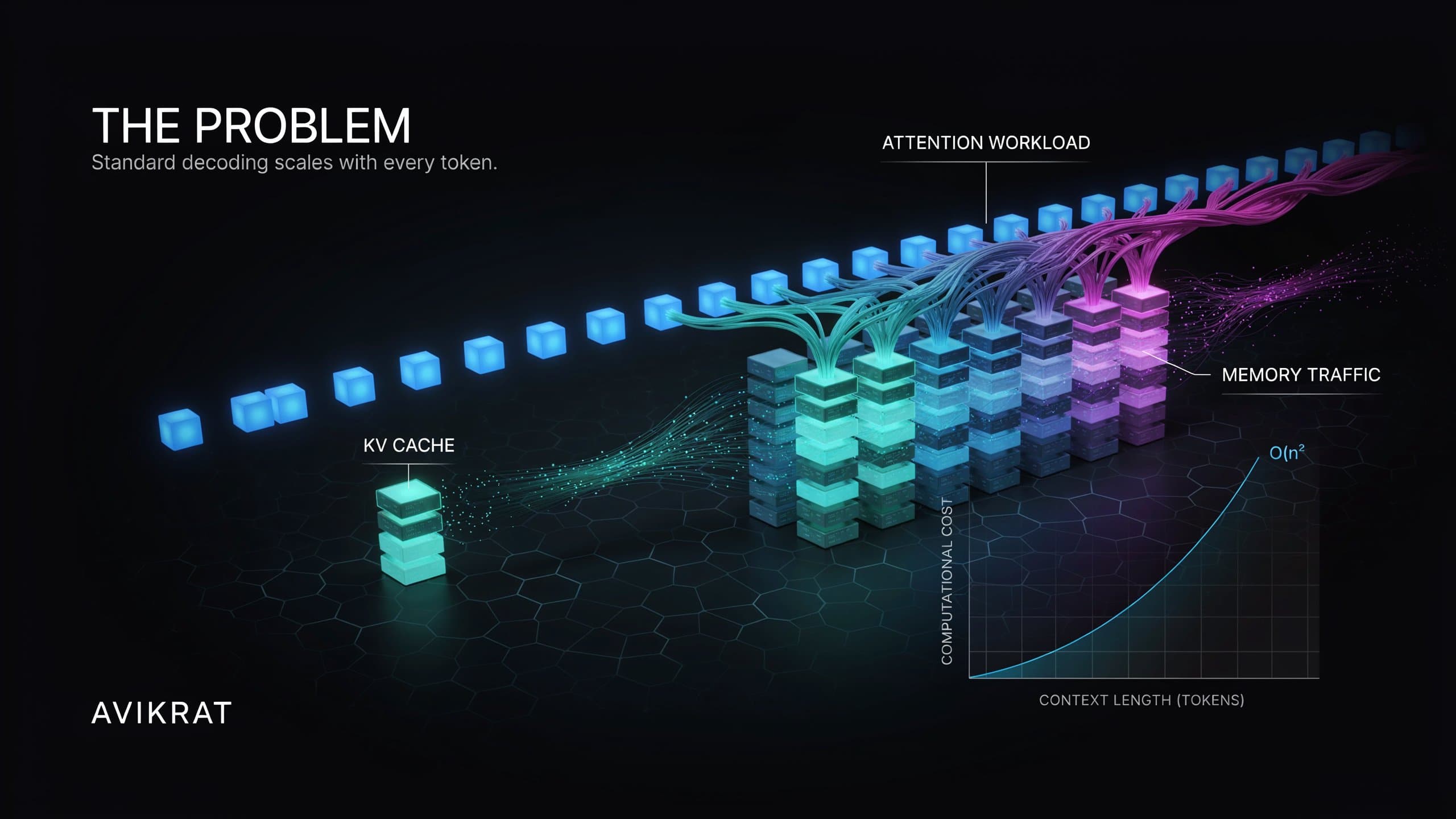
Conceptual visualization of growing context — not measured benchmark data.
The Shift
What if long history
became state?
AVIKRAT's approach is based on a simple architectural shift: process the long history globally, preserve the useful information in a compact persistent state, and use a short local token window for ongoing decoding.
Instead of re-reading the full context at every step, the long history is read once by a global prefill and collapsed into a dense, fixed-size representation. The full original tokens are no longer carried forward — the state is.
Ongoing decoding then operates on that persistent state plus a short recent window, so the active working set stays bounded as the conversation grows.
This is a conceptual image of the intended architecture, not a measured model.
The Pipeline
Four stages. One persistent state.
Each stage is a single, well-defined step. Together they describe how the simulator intends to turn unbounded conversations into bounded compute.
Global Prefill
Read the full history once.
Compact State
Persist a small learned memory.

Local Decode
Use a short recent window only.

Next Token
Generate efficiently.
Phase labels describe the intended pipeline of the Hidden State Simulator, not measured results. Images are conceptual.
The Comparison
Two ways to carry context.
One carries everything forward. The other carries a compact state and decodes locally. The difference shows up as context grows.
Traditional Inference
- KV cache grows with every extra token
- Memory and attention cost rise with context length
- Long conversations become increasingly expensive to maintain
Hidden-State Simulator
- Compact persistent state is kept fixed-size
- Local decoding operates on a short token window
- Inference cost is designed to stay much flatter as context increases
Conceptual visualization of a compact persistent state — not a measured chart.
Applications
The opportunity is bigger than one model.
A bounded, persistent context opens up workloads where long-running or continuous state currently gets too expensive.
Enterprise Copilots
Persistent conversations and large document sessions.
Edge AI
Smaller persistent memory can be friendlier to constrained devices.
Agent Infrastructure
Long-running workflows can remain active without exploding state cost.
Real-Time Systems
Bounded memory can make continuous context more practical.
Working Simulator
From architecture to working simulator.
A working simulator already predicts hidden-state structure and tracks validation behavior.
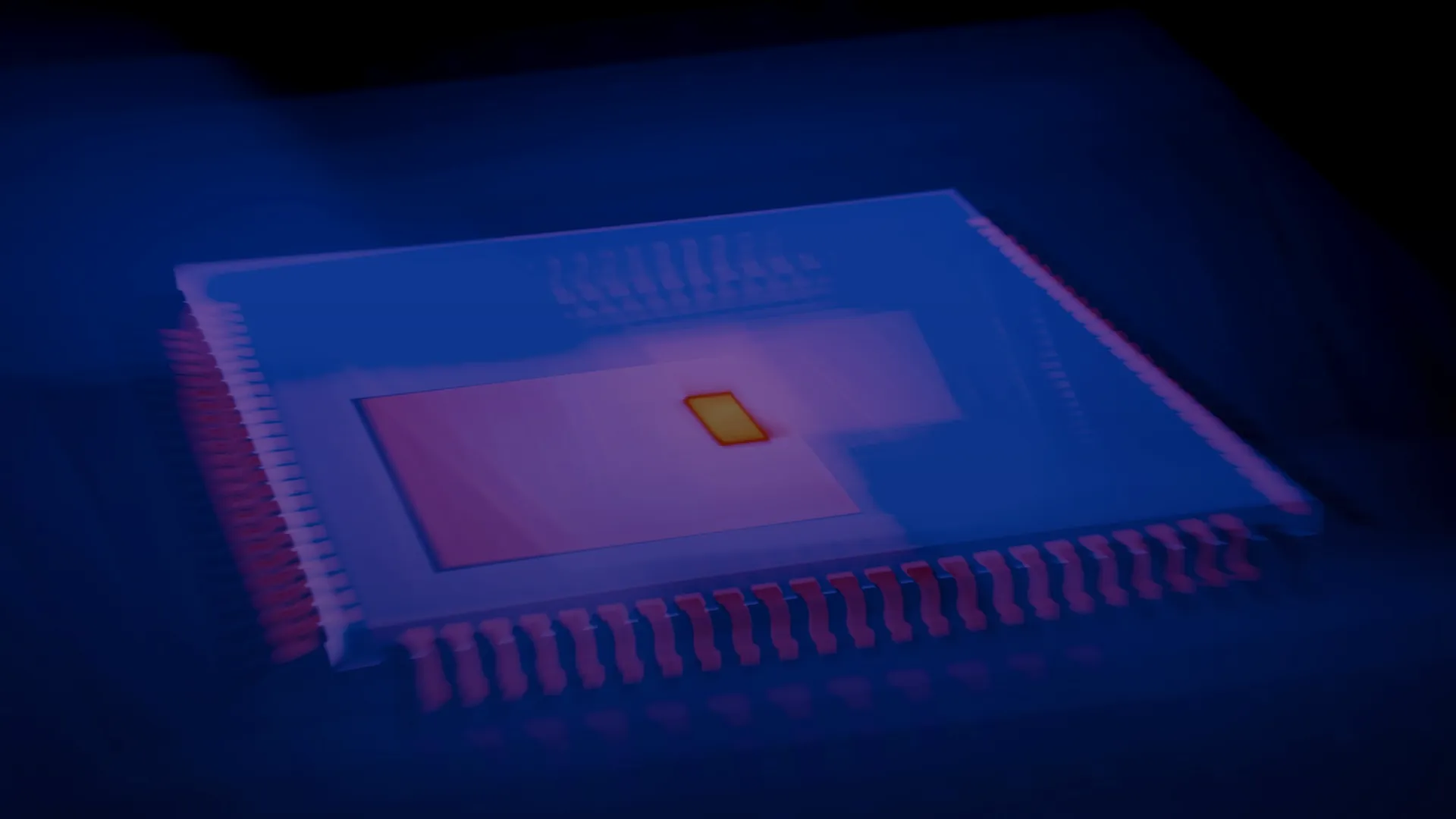
This provides the concrete base for next-token perplexity and cost benchmarking.
- True vs Predicted Context Slices
- Error Metrics
- Cosine Similarity
- Checkpoint Selection
The simulator provides these capabilities — no numeric results are claimed.
The Roadmap
The next step is measurement.
The architecture is directional. Turning it into infrastructure means validating each claim against matched baselines and real workloads.
- Perplexity
Quality must remain competitive.
- Latency
Decoding should improve.
- Memory
Memory should remain bounded as context grows.
- Scaling
Measure behavior across increasing context lengths.
Early-stage research targets — no benchmark results are claimed yet.
The Target
Target: up to 90% lower long-context inference cost
The current pitch targets long-context inference cost reduction through compact-state decoding. This target must be validated against matched baselines while maintaining competitive model quality.
07 · COLLABORATION DIRECTIVE
Help us turn the simulator into infrastructure.
We are seeking benchmark collaborators, enterprise pilot partners, and systems engineers to advance constant-memory AI inference.
hello@avikrat.org · +91 8949207258